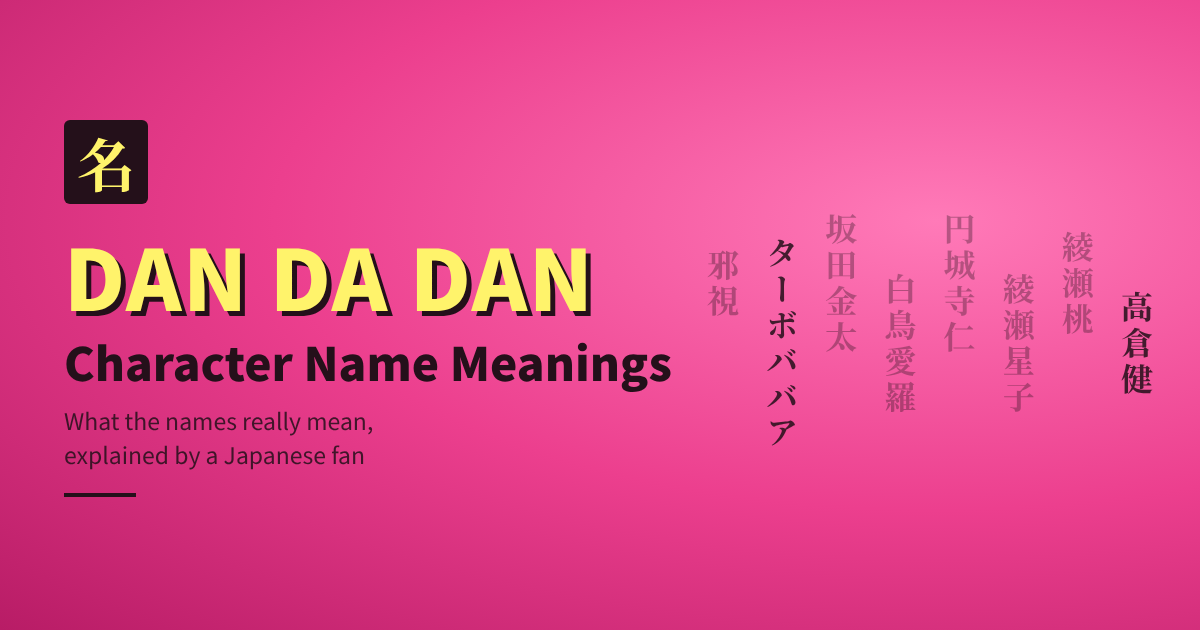
Ever wondered what names like Okarun, Momo, or Turbo Granny actually mean? In Japanese, names are written in kanji or katakana, and each piece has its own meaning. So a name can say a lot about a character.
On this page, I break down the names of Dandadan characters as a Japanese fan. For each one, you get the meaning of each part, what the name means in the story, how it feels to Japanese ears, and whether it is a real name in Japan.
Just tap a character name below to open their section. I keep the facts I checked separate from my own take, so you always know which is which.
Spoiler note: Some sections touch on later parts of the story. When they do, I put a spoiler warning right before that part.
Takakura Ken / Okarun(高倉健)
- Okarun Real Name Meaning: Who Is Takakura Ken?
- What Does Ayase Momo Name Mean?
- What Does Ayase Seiko Name Mean?
- Jiji Real Name Meaning: Who Is Enjoji Jin?
- What Does Shiratori Aira Name Mean?
- What Does Sakata Kinta Name Mean?
- What Does Turbo Granny Mean in Japanese? Turbo Babaa Explained
- What Does Evil Eye Mean in Dandadan? Jashi Name Meaning
Okarun Real Name Meaning: Who Is Takakura Ken?
Name: Takakura Ken(高倉 健)
Reading: Ta-ka-ku-ra Ke-n. In Japan, the family name comes first.
Nickname: Okarun(オカルン)
The Kanji One by One
- Taka(高)= “high” or “tall”
- Kura(倉)= “storehouse”
- Ken(健)= “healthy” or “strong”
Read literally, Takakura Ken is something like “the strong one of the tall storehouse.” But honestly, nobody in Japan reads this name for its kanji. To us, it is the name of a legend.
Why Japanese Parents Choose the Name Ken
Surnames are inherited in Japan, so parents only choose the given name. 健 carries a simple, strong wish: grow up healthy and tough.
It has been a favorite for a long time. Names with 健, like 健一 or 健太郎, were popular in the Showa era. Then Kenta(健太)stayed in the top 3 of Meiji Yasuda’s boys’ ranking every year from 1989 to 1997.
What the Name Means in the Story
Here is the joke. Takakura Ken(高倉健)is also the name of one of Japan’s most famous movie stars. He lived from 1931 to 2014 and was known as the ultimate tough, silent hero. His real name was actually Oda Goichi(小田剛一), so Takakura Ken was his stage name.
His whole image is what we call koha(硬派). Literally it means “the hard school,” and it describes a man who is serious, quiet, and true to his principles.
A koha guy does not flirt around or show off. He keeps his feelings inside and stays loyal to one person.
And in Japan, this type is really, really popular. People see a koha man as sincere and trustworthy, the kind of guy you can count on. Takakura Ken was basically the face of that ideal.
In the story, Momo’s ideal man is that actor. So she is too embarrassed to call her nerdy classmate by the same name. Since he loves the occult, she calls him Okarun instead.
How It Feels to Japanese Ears
This part is my take. For Japanese people, especially older ones, hearing “Takakura Ken” instantly brings that actor to mind. It is a bit like a skinny, nervous kid being named Clint Eastwood.
And that is exactly why it works. Okarun looks like the total opposite of a tough guy. But when he says he will become a monster for the girl he likes, he lives up to the name.
Is Takakura Ken a Common Name in Japan?
Takakura(高倉)is a fairly common surname. About 23,200 people in Japan have it, ranking around 804th. It is especially common in Fukuoka and Oita in Kyushu(九州), Japan’s southern island.
So a real-life Takakura family could totally name their son Ken. I just bet people would ask about the actor every single time.
Source: 名字由来net (myoji-yurai.net)
Ayase Momo(綾瀬桃)
What Does Ayase Momo Name Mean?
Name: Ayase Momo(綾瀬 桃)
Reading: A-ya-se Mo-mo. In Japan, the family name comes first.
The Kanji One by One
- Aya(綾)= “patterned silk,” a fabric woven with designs
- Se(瀬)= “rapids” or “shallow stream”
- Momo(桃)= “peach”
Read literally, Ayase Momo is something like “a peach by the silky stream.” Pretty, soft, and a little elegant.
Why Japanese Parents Choose the Name Momo
Surnames are inherited in Japan, so parents only choose the given name. Peaches are tied to spring and to Hinamatsuri(ひな祭り)= “Girls’ Day” on March 3, also called the Peach Festival. So 桃 has a cute, springy, very girly feel.
The peach also stands for long life and protection from evil in East Asian culture. So parents may hope for a girl who grows up healthy and safe from bad luck.
What the Name Means in the Story
Momo comes from a family of spirit mediums, and she fights ghosts and yokai. I could not find any official comment from the author about why he chose her name.
How It Feels to Japanese Ears
This part is my take. In everyday life, when Japanese people hear the name Momo, we just think it sounds cute. It is soft, short, and easy to say, like a nickname you want to call out.
Here is a fun fact that not many Japanese people know, though. In the Kojiki(古事記), Japan’s oldest book of myths, the god Izanagi escapes from the land of the dead by throwing three peaches at the demons chasing him.
Most of us would never think of that when we hear “Momo.” But for a girl who fights ghosts, it is a pretty cool hidden link.
Ayase also sounds pretty and a little glamorous. Put that next to Momo’s loud, tough gyaru(ギャル)= “flashy party girl” attitude, and you get a fun gap.
Is Ayase Momo a Common Name in Japan?
Ayase(綾瀬)is a real but very rare surname. Only about 60 people in Japan have it, ranking around 39,535th. Most of them live in Tokyo.
You see it more often as a place name, like Ayase in Tokyo or Ayase City in Kanagawa.
Momo, on the other hand, is a well-loved girls’ name. Japanese naming guides say names starting with “mo,” like Momo or Moe, have become popular in recent years.
Source: 名字由来net (myoji-yurai.net)
Ayase Seiko(綾瀬星子)
What Does Ayase Seiko Name Mean?
Name: Ayase Seiko(綾瀬 星子)
Reading: A-ya-se Se-i-ko. In Japan, the family name comes first.
Stage name: Dodoria Santa(ドドリア三太)
The Kanji One by One
- Aya(綾)= “patterned silk,” a fabric woven with designs
- Se(瀬)= “rapids” or “shallow stream”
- Sei(星)= “star”
- Ko(子)= “child,” a classic ending for girls’ names
Read literally, Seiko means “star child.” She shares the surname Ayase with Momo, so the two of them make a cute pair: a peach and a star.
Why Japanese Parents Choose the Name Seiko
Surnames are inherited in Japan, so parents only choose the given name. 星子 is usually chosen with a wish for a girl who shines like a star.
The ending 子 is the key here. For decades, girls’ names ending in “-ko” ruled Japan. Kazuko(和子)was number one in Meiji Yasuda’s ranking 23 times between 1927 and 1952.
What the Name Means in the Story
Seiko is Momo’s grandma and a powerful spirit medium. On TV, though, she works as a “fake” medium under the stage name Dodoria Santa. I could not find any official comment from the author about either name.
How It Feels to Japanese Ears
This part is my take. Seiko sounds like a classic grandma-generation name, thanks to that “-ko” ending. That said, girls are still given “-ko” names today, so it does not sound old or strange at all.
It just fits her age perfectly, even if she looks way too young and stylish to be anyone’s grandma.
Dodoria Santa, on the other hand, just sounds silly. Dodoria is the name of a villain in Dragon Ball Z, and Santa(三太)sounds like an old-fashioned boy’s name. A grandma using that as her psychic name? It sounds like a joke on purpose.
Is Ayase Seiko a Common Name in Japan?
Ayase(綾瀬)is a very rare surname, with only about 60 people in all of Japan. You can read more about it in Momo’s section above.
Names ending in “-ko” faded after the Showa(昭和)era, Japan’s 1926 to 1989 period. Parents started picking names by sound and image instead. They are still around today, though, and cute ones like Riko(莉子)have made a comeback.
Source: 名字由来net (myoji-yurai.net)
Enjoji Jin / Jiji(円城寺仁)
Jiji Real Name Meaning: Who Is Enjoji Jin?
Name: Enjoji Jin(円城寺 仁)
Reading: En-jo-u-ji Ji-n. In Japan, the family name comes first.
Nickname: Jiji(ジジ)
The Kanji One by One
- En(円)= “circle” or “round”
- Jo(城)= “castle”
- Ji(寺)= “temple”
- Jin(仁)= “compassion” or “kindness to others”
Read literally, Enjoji Jin is something like “the kind one from Round Castle Temple.” The surname is said to come from a place called Enjoji in Chiba, near Tokyo.
Why Japanese Parents Choose the Name Jin
Surnames are inherited in Japan, so parents only choose the given name. 仁 is the top virtue in Confucian teaching, meaning warm care for other people. Parents pick it hoping their son will be kind and loved by everyone around him.
It is a popular kanji for boys, too. It ranked 22nd among boys’ name kanji in Meiji Yasuda’s 2020 ranking.
What the Name Means in the Story
Jiji is Momo’s childhood friend and her first crush. He acts loud and flirty, but he has a really warm heart. I could not find any official comment from the author about his name.
Spoiler warning for season 2 below.
Still, the kanji 仁 fits him well. He even feels sorry for the Evil Eye and lets it share his body. That is about as “compassion” as it gets.
How It Feels to Japanese Ears
This part is my take. Enjoji sounds grand and old-school, like a family with a long history. It is a cool, slightly fancy surname.
The nickname Jiji is the funny part. My guess is that it comes from the two “ji” sounds in Enjo-ji Jin. But in Japanese, jiji(爺)also means “old man” or “gramps.” So the tall, handsome guy of the group is basically nicknamed “Grandpa.”
Is Enjoji Jin a Common Name in Japan?
Enjoji(円城寺)is a real surname. About 2,400 people in Japan have it, ranking around 4,462nd. It is most common in Chiba and Saga.
The single kanji 仁 is also used on its own as a boys’ name. Fun fact: if you have read my Jujutsu Kaisen page, Itadori Yuji has the same kanji 仁 at the end of his name.
Source: 名字由来net (myoji-yurai.net)
Shiratori Aira(白鳥愛羅)
What Does Shiratori Aira Name Mean?
Name: Shiratori Aira(白鳥 愛羅)
Reading: Shi-ra-to-ri A-i-ra. In Japan, the family name comes first.
The Kanji One by One
- Shira(白)= “white”
- Tori(鳥)= “bird”
- Ai(愛)= “love”
- Ra(羅)= “thin silk” or “gauze”
Shiratori(白鳥)means “white bird,” and it is also the Japanese word for “swan.” So read literally, her name is something like “the swan wrapped in silk and love.” Very princess.
Why Japanese Parents Choose the Name Aira
Surnames are inherited in Japan, so parents only choose the given name. 愛 is a classic for girls, carrying a wish for a kind, loving heart. Names with 愛 had a big boom from the late Showa(昭和)era into the Heisei(平成)era, roughly the 1980s to 2000s.
羅 adds the light, elegant image of fine silk. Together, 愛羅 feels sweet and a little glamorous.
What the Name Means in the Story
Aira is the school’s most popular beauty. On the outside she is sweet to everyone, but inside she is self-centered and sure she is a “chosen” girl. I could not find any official comment from the author about her name.
How It Feels to Japanese Ears
This part is my take. Shiratori Aira sounds like the name of a heroine in an old girls’ manga. Elegant surname, sparkly first name, the full package.
That is exactly why it fits her so well. It is the perfect “I am the main character” name for a girl who truly believes she is the main character.
Here is a fun bonus for Naruto fans. Gaara’s name is written 我愛羅, and the last two kanji are the same 愛羅 as Aira. Same kanji, very different vibes.
Is Shiratori Aira a Common Name in Japan?
Shiratori(白鳥)is a fairly common surname. About 24,100 people in Japan have it, ranking around 779th. It is most common in Chiba, Tokyo, and Shizuoka.
As for Aira, I could not find data on how common it is. To me, though, it has a modern, stylish sound that stands out.
Source: 名字由来net (myoji-yurai.net)
Sakata Kinta(坂田金太)
What Does Sakata Kinta Name Mean?
Name: Sakata Kinta(坂田 金太)
Reading: Sa-ka-ta Ki-n-ta. In Japan, the family name comes first.
The Kanji One by One
- Saka(坂)= “slope” or “hill”
- Ta(田)= “rice field”
- Kin(金)= “gold”
- Ta(太)= “big” or “thick”
Sakata(坂田)simply means “rice field on a slope.” Kinta(金太)is something like “big gold.” Pretty flashy for a guy who mostly gets ignored by girls.
Why Japanese Parents Choose the Name Kinta
Surnames are inherited in Japan, so parents only choose the given name. 太 is a classic ending for boys, carrying a wish for a big, healthy, strong kid. Names like Kenta(健太)and Shota(翔太)were the top boys’ names in Japan around the 1990s.
金 brings the image of gold, something precious and shining. Put together, the wish would be “a strong boy who shines.”
What the Name Means in the Story
Kinta is Okarun’s classmate with glasses and a center part. He is a total chuunibyo(中二病), meaning a teen who is still deep in his “I am secretly special” phase. He loves robot anime and sci-fi, and that wild imagination turns him into a real fighter later on.
I could not find any official comment from the author about his name.
How It Feels to Japanese Ears
This part is my take. Every Japanese person knows Kintaro(金太郎). He is a folk-tale hero, a super strong boy who wrestled a bear. I heard his story at bedtime when I was a kid, too. Kintaro dolls are still displayed for Children’s Day in May.
Here is a little-known detail, though. Kintaro’s grown-up name was Sakata no Kintoki(坂田金時). Honestly, I do not think most Japanese people would link Sakata Kinta to him right away.
But once you notice it, it is fun. Sakata plus a name starting with Kin feels like a mini version of a legendary strongman. That suits a nerdy kid who dreams of being a hero.
Fun fact for Gintama fans. Sakata Gintoki(坂田銀時)was also named after Sakata no Kintoki. He just swapped gold(金)for silver(銀).
Is Sakata Kinta a Common Name in Japan?
Sakata(坂田)is a common surname. About 86,100 people in Japan have it, ranking around 250th. It is most common in Tokyo, Fukuoka, and Kumamoto.
As for Kinta, I could not find data on how common it is. To me, it sounds rare today and a bit old-school and playful.
Source: 名字由来net (myoji-yurai.net)
Turbo Granny(ターボババア)
What Does Turbo Granny Mean in Japanese? Turbo Babaa Explained
Name: Turbo Babaa(ターボババア)
Reading: Ta-a-bo Ba-ba-a. It is written in katakana, not kanji.
The Words One by One
- Turbo(ターボ)= the English word “turbo,” as in a turbo engine
- Babaa(ババア)= “old woman,” but in a rude way, like “old hag.” The kanji is Baba(婆)= “old woman”
The polite word is obaasan(おばあさん). Babaa is what you say when you are being mean. So “Turbo Granny” is actually a cute translation. “Turbo Hag” is closer to how it sounds in Japanese.
Where the Name Turbo Granny Comes From
She is based on a real Japanese urban legend. It spread in the 1990s. A driver on a highway or in a tunnel at night looks out the window, and an old woman is running right next to the car at 100 to 140 km/h.
The legend has many local names, like Turbo Baachan(ターボばあちゃん), Jet Babaa(ジェットババア), and Hyakkiro Babaa(100キロババア), meaning “100 km Hag.” Turbo Babaa is often linked to Mount Rokko(六甲山)in Hyogo. In some versions, she even has a paper on her back that says “turbo.”
What the Name Means in the Story
In Dandadan, she haunts a tunnel and can always run at top speed, anywhere. Her name is basically her job description.
Spoiler warning for early episodes below.
Later she gets sealed inside a maneki-neko(招き猫), a lucky cat doll, and becomes the team mascot. A scary “hag” turning into a cute cat is a big part of the joke.
How It Feels to Japanese Ears
This part is my take. To me, the name is more funny than scary. Mixing a cool English word with a rude word for an old lady is pure comedy.
Fun fact. The anime first aired in Japan in a TV time slot called Super Animeism TURBO. A coincidence, but a perfect one.
Is Turbo Granny Well Known in Japan?
Babaa is not a real name, of course. As for the legend, it is a bit old now. It was mostly talked about in the 1990s, and the story was told in many places under different names.
This is my take, but I do not think every Japanese person knows it. People who were kids back then, or who love scary stories, might remember it. For many younger fans, Dandadan is probably where they first met her. Honestly, Dandadan is where I first heard of her, too.
Sources: Animate Times, Bunshun Online
Evil Eye / Jashi(邪視)
What Does Evil Eye Mean in Dandadan? Jashi Name Meaning
Name: Jashi(邪視)
Reading: Ja-shi. In the English version, he is simply called Evil Eye.
The Kanji One by One
- Ja(邪)= “evil” or “wicked”
- Shi(視)= “to look” or “sight”
So Jashi is literally “evil sight.” Both kanji show up in everyday words. 邪 is in kaze(風邪), “a cold,” and 視 is in shiryoku(視力), “eyesight.”
Where the Name Evil Eye Comes From
Jashi is the Japanese word for the “evil eye,” the belief that a glare can bring bad luck or harm. Japanese dictionaries explain it this way. The belief is found all over the world, especially around the Mediterranean, the Middle East, and South Asia.
Here is a fun fact. The word 邪視 is said to be a translation of the English “evil eye” by Minakata Kumagusu(南方熊楠), a famous Japanese folklorist. So the name has English roots, in a way.
Some Japanese fans also think his look was inspired by internet horror stories like Kunekune(くねくね). That is only a fan theory, though. I could not find any official comment from the author.
What the Name Means in the Story
He first appears haunting Jiji’s new house. He has a twisted face, very long arms, and wears only briefs. True to his name, his gaze is extremely dangerous.
Big spoiler warning for season 2 below.
He was once a human boy, locked away as a child and later offered as a sacrifice by the Kito family. His anger turned him into Evil Eye. Later he ends up sharing Jiji’s body, and he still acts like a kid.
How It Feels to Japanese Ears
This part is my take. Jashi sounds hard and creepy, like a word from an old book about curses. It is not a name, just a label for what he does.
That is what makes it sad once you know his past. He never got a real name in the story, only a word for the scary thing he became.
Is Jashi a Common Word in Japan?
Not really. It is in the dictionary, but I think most Japanese people never use it in daily life. People who like folklore or the occult might know it. For many fans, Dandadan is probably the first place they saw it.
Sources: Kotobank, Osaka University repository
Which name surprised you the most? And which character should I add next? Let me know in the comments.
Back to all anime character name meanings
DAN DA DAN © Yukinobu Tatsu / Shueisha
コメント