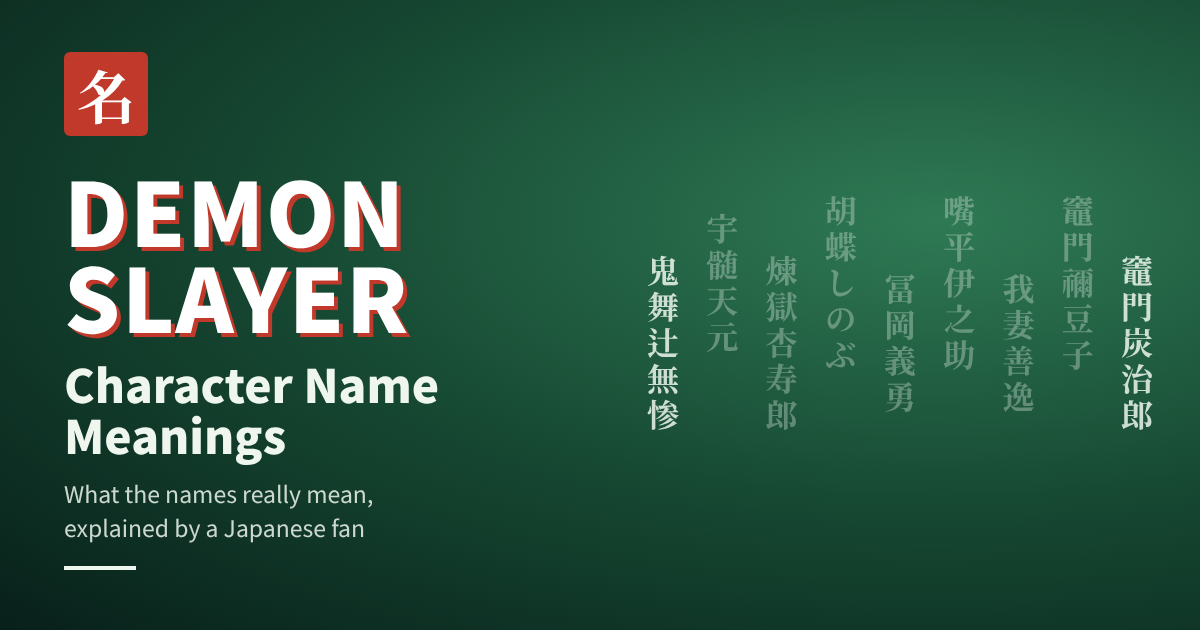
Ever wondered what names like Tanjiro, Nezuko, or Muzan actually mean? In Japanese, names are written in kanji, and each kanji has its own meaning. So a name can say a lot about a character.
Let me start with the title itself. In Japan, the series is called Kimetsu no Yaiba(鬼滅の刃). Ki(鬼)= “demon,” metsu(滅)= “destroy,” no(の)= “of,” and yaiba(刃)= “blade.” So it is roughly “the blade that destroys demons.”
On this page, I break down the names of Demon Slayer characters as a Japanese fan. For each one, you get the meaning of each kanji, what the name means in the story, how it feels to Japanese ears, and whether it is a real name in Japan.
Just tap a character name below to open their section. I keep the facts I checked separate from my own take, so you always know which is which.
Spoiler note: Some sections touch on later parts of the story. When they do, I put a spoiler warning right before that part.
Kamado Tanjiro(竈門炭治郎)
- What Does Kamado Tanjiro Name Mean?
- What Does Kamado Nezuko Name Mean?
- What Does Agatsuma Zenitsu Name Mean?
- What Does Hashibira Inosuke Name Mean?
- What Does Tomioka Giyu Name Mean?
- What Does Kocho Shinobu Name Mean?
- What Does Rengoku Kyojuro Name Mean?
- What Does Uzui Tengen Name Mean?
- What Does Kibutsuji Muzan Name Mean?
What Does Kamado Tanjiro Name Mean?
Name: Kamado Tanjiro(竈門 炭治郎)
Reading: Ka-ma-do Ta-n-ji-ro-u. In Japan, the family name comes first.
The Kanji One by One
- Kama(竈)= “cooking stove,” the old wood-burning kind
- Do(門)= “gate”
- Tan(炭)= “charcoal”
- Ji(治)= “to settle,” “to govern,” or “to heal”
- Ro(郎)= “son,” a classic ending for boys’ names
Kamado(竈)on its own is the Japanese word for a traditional stove. So read literally, his name is something like “the charcoal son of the stove gate.” Fire, fire, and more fire.
Why Japanese Parents Choose the Name Tanjiro
Surnames are inherited in Japan, so parents only choose the given name. 郎 has long been used for boys and heirs, and 治 carries the image of keeping things calm and in order.
Here is a fun detail. Old Japanese boys’ names often showed birth order. Taro(太郎)was the first son, with 太 = “big.” Jiro(次郎)was the second, with 次 = “next.” Saburo(三郎)was the third, with 三 = “three.”
But Tanjiro is the eldest son. His “ji” is 治, not 次, so there is no number hidden in his name. These birth-order names were once super common, but I hardly ever see them today.
What the Name Means in the Story
Tanjiro’s family makes and sells charcoal in the mountains. So both his surname and his given name point straight to his family job. I could not find any official comment from the author about his name.
The fire theme keeps going, too. His family passes down a fire god dance called Hinokami Kagura(ヒノカミ神楽), which becomes a big part of how he fights.
How It Feels to Japanese Ears
This part is my take. Tanjiro sounds warm and old-fashioned, like a boy from the Taisho(大正)era, Japan’s 1912 to 1926 period. That fits the setting perfectly.
The kanji 竈 is famous for being hard. Most Japanese people can read kamado, but very few could write 竈 from memory.
Fun fact: there are real shrines called Kamado Shrine(竈門神社), like one in Beppu, Oita. It became a popular spot for fans to visit. As far as I could find, though, there is no official word that his name came from there.
Is Kamado Tanjiro a Common Name in Japan?
Kamado(竈門)is a real surname, but one of the rarest in Japan. In 2020 data, only about 10 people had it, ranking around 89,033rd.
As for Tanjiro, I could not find naming data for it. To me, it feels like a name you would almost never meet today.
Source: 名字由来net (myoji-yurai.net)
Kamado Nezuko(竈門禰豆子)
What Does Kamado Nezuko Name Mean?
Name: Kamado Nezuko(竈門 禰豆子)
Reading: Ka-ma-do Ne-zu-ko. In Japan, the family name comes first.
The Kanji One by One
- Kama(竈)= “cooking stove,” the old wood-burning kind
- Do(門)= “gate”
- Ne(禰)= “ancestral shrine,” a place to honor family spirits
- Zu(豆)= “bean”
- Ko(子)= “child,” a classic ending for girls’ names
Read literally, Nezuko is something like “the bean child of the ancestral shrine.” It sounds a little mysterious, a little sacred, and a little cute.
Why Japanese Parents Choose the Name Nezuko
Surnames are inherited in Japan, so parents only choose the given name. 禰 is a rare kanji, but it is allowed in Japanese names. You mostly see it in negi(禰宜), a title for Shinto shrine priests.
So 禰 gives a name a sacred, old-fashioned feel. Add the “-ko” ending, and it becomes a classic girls’ name shape.
What the Name Means in the Story
Nezuko is Tanjiro’s little sister, who is turned into a demon in the first episode. As far as I could find, there is no official word on where her name came from.
Fans love one theory, though. In Japan, on Setsubun(節分)in February, people throw beans to drive demons out of the house. So a girl named “bean” becoming a demon is quite the twist.
How It Feels to Japanese Ears
This part is my take. Nezuko sounds soft and cute, but the kanji 禰 is something most of us rarely see. Many Japanese people probably could not read it before the anime.
Here is a fun fact. Nezuko(ネズコ)is also the name of a real Japanese tree, a kind of thuja. It is written 鼠子 in kanji, which means “mouse child.”
Her family lives in the mountains, and her brothers have names like Takeo(竹雄), with 竹 = “bamboo.” So a plant link may not be pure chance. That is just my guess, though.
Is Kamado Nezuko a Common Name in Japan?
Kamado(竈門)is one of the rarest surnames in Japan. In 2020 data, only about 10 people had it. You can read more in Tanjiro’s section above.
As for Nezuko, I could not find naming data for it. Girls’ names ending in “-ko” are still used today, but to me, Nezuko feels like a name you would almost never meet in real life.
Source: 名字由来net (myoji-yurai.net)
Agatsuma Zenitsu(我妻善逸)
What Does Agatsuma Zenitsu Name Mean?
Name: Agatsuma Zenitsu(我妻 善逸)
Reading: A-ga-tsu-ma Ze-n-i-tsu. In Japan, the family name comes first.
The Kanji One by One
- Aga(我)= “I” or “my”
- Tsuma(妻)= “wife”
- Zen(善)= “good” or “virtue”
- Itsu(逸)= “to run away,” but also “outstanding”
Yes, his surname literally reads “my wife.” And 逸 has two faces. It started as a picture of a rabbit running away, but it is also used in words like itsuzai(逸材)= “a rare talent.”
Why Japanese Parents Choose the Name Zenitsu
Surnames are inherited in Japan, so parents only choose the given name. 善 is a simple, honest kanji, carrying a wish for a good-hearted child.
逸 is much rarer in names. If parents picked it, they would mean the “outstanding” side, not the running-away side.
What the Name Means in the Story
Zenitsu is a total coward who screams, cries, and begs girls to marry him. But when he passes out, he fights with lightning-fast Thunder Breathing. As far as I could find, there is no official word on where his name came from.
How It Feels to Japanese Ears
This part is my take. Agatsuma is a normal surname, so we do not usually think of “my wife” when we hear it. But for a guy who is desperate to get married, reading the kanji is pretty funny.
And 逸 fits him almost too well. He runs away like a rabbit, yet he is a rare talent when it counts. To me, the whole name sums up his gap in just two kanji.
Zenitsu also has an old-fashioned sound that fits the Taisho-era world of the story perfectly. At the same time, it sounds cool enough to work as a name in modern Japan, too.
Is Agatsuma Zenitsu a Common Name in Japan?
Agatsuma(我妻)is a real surname, and the most common one in this list. About 17,000 people in Japan have it, ranking around 1,029th. It is most common in Miyagi, in northeastern Japan.
Fun fact: 我妻 can be read many ways, like Wagatsuma or Azuma. As for Zenitsu, I could not find naming data, and it feels very rare to me.
Source: 名字由来net (myoji-yurai.net)
Hashibira Inosuke(嘴平伊之助)
What Does Hashibira Inosuke Name Mean?
Name: Hashibira Inosuke(嘴平 伊之助)
Reading: Ha-shi-bi-ra I-no-su-ke. In Japan, the family name comes first.
The Kanji One by One
- Hashi(嘴)= “beak,” like a bird’s beak
- Bira(平)= “flat”
- I(伊)= an old word for “he” or “that one,” often used just for its sound
- No(之)= “of,” a linking kanji
- Suke(助)= “help”
Read literally, his surname means “flat beak,” which is already a strange start. And Inosuke is less about meaning and more about sound, as I will explain below.
Why Japanese Parents Choose the Name Inosuke
Surnames are inherited in Japan, so parents only choose the given name. Names ending in “-nosuke”(之助)are classic old-style boys’ names, like something from a samurai drama.
助 means “help,” so the ending carries a wish for a boy who supports and helps others. Inosuke is even a famous real name in sumo. Shikimori Inosuke(式守伊之助)is a title passed down to top sumo referees since the Edo(江戸)era.
What the Name Means in the Story
Inosuke was left in the mountains as a baby and raised by wild boars. He always wears a boar’s head, and his catchphrase is chototsu moshin(猪突猛進)= “charging ahead like a boar.”
As far as I could find, there is no official word on where his name came from.
How It Feels to Japanese Ears
This part is my take. I just like how the “Ino” in Inosuke sounds a bit like inoshishi(猪)= “wild boar.” For a boy raised by boars, that is a nice little touch.
Hashibira, on the other hand, sounds unusual and a bit wild. The kanji 嘴 is one most of us rarely write, which fits a boy who grew up outside normal society.
Is Hashibira Inosuke a Common Name in Japan?
As far as I could find, Hashibira(嘴平)is not a real surname in Japan. It seems to be made up for the story.
Inosuke is a real but very old-fashioned name. Names ending in “-suke” are still used today, but to me, Inosuke feels like a name from a historical drama.
Tomioka Giyu(冨岡義勇)
What Does Tomioka Giyu Name Mean?
Name: Tomioka Giyu(冨岡 義勇)
Reading: To-mi-o-ka Gi-yu-u. In Japan, the family name comes first.
The Kanji One by One
- Tomi(冨)= “wealth,” a variant of the usual 富
- Oka(岡)= “hill”
- Gi(義)= “justice” or “doing what is right”
- Yu(勇)= “courage”
Read literally, his name is something like “justice and courage from the rich hill.” Pretty much the ideal name for a demon slayer.
Look closely at 冨. The usual kanji 富 has a little dot on top, but his 冨 does not. It is an older variant that is still allowed in names.
Why Japanese Parents Choose the Name Giyu
Surnames are inherited in Japan, so parents only choose the given name. 義 and 勇 together carry a wish for a boy who is brave and does the right thing.
Here is a fun detail. Real people with the name 義勇 usually read it Yoshitake or Yoshio. Giyu is the reading you would use for the word itself, which makes it sound almost like a title.
What the Name Means in the Story
Giyu is the Water Hashira(柱), one of the top swordsmen of the Demon Slayer Corps. He is the first slayer Tanjiro meets, and he chooses to spare Nezuko when the rules say he should kill her.
Bending the rules to protect what is right is very “justice and courage.” As far as I could find, though, there is no official word on where his name came from.
How It Feels to Japanese Ears
This part is my take. Because Giyu is read like a real word, his name sounds a bit stiff and heroic. That fits a quiet, serious guy who rarely smiles.
Tomioka, on the other hand, sounds very normal to us. It is a surname you could easily meet at school or work. That mix of normal and heroic feels very him.
Is Tomioka Giyu a Common Name in Japan?
Tomioka(冨岡)with the dotless 冨 is a real surname. About 8,300 people in Japan have it, ranking around 1,831st. The version with the usual 富 is even more common.
As for Giyu, I could not find naming data for that reading. To me, it feels very rare as a real name.
Source: 名字由来net (myoji-yurai.net)
Kocho Shinobu(胡蝶しのぶ)
What Does Kocho Shinobu Name Mean?
Name: Kocho Shinobu(胡蝶 しのぶ)
Reading: Ko-cho-u Shi-no-bu. In Japan, the family name comes first.
The Kanji One by One
- Ko(胡)= originally “foreign,” as in goma(胡麻)= “sesame”
- Cho(蝶)= “butterfly”
- Shinobu(しのぶ)= written in hiragana, so no kanji
Together, kocho(胡蝶)is an old, elegant word for “butterfly.” It even appears as a chapter title in The Tale of Genji. So her surname basically means “Butterfly.”
Why Japanese Parents Choose the Name Shinobu
Surnames are inherited in Japan, so parents only choose the given name. Shinobu is a real name, used for both girls and boys. A famous example is the actress Otake Shinobu(大竹しのぶ), who also writes it in hiragana.
Writing a name in hiragana makes it look soft and gentle. It also leaves the meaning open, because the sound “shinobu” can match several words.
- 忍ぶ(shinobu)= “to endure” or “to hide”
- 偲ぶ(shinobu)= “to remember someone fondly”
What the Name Means in the Story
Shinobu is the Insect Hashira. She wears a butterfly hair ornament, fights with poison, and runs the Butterfly Mansion where wounded slayers heal. Her surname fits her almost too well.
Spoiler warning: the next part mentions her backstory.
She is always smiling, but she is holding back deep anger toward demons. After losing her older sister, she tries to act gentle the way her sister did. As far as I could find, there is no official word on her name, but “to endure” and “to remember someone fondly” both fit her painfully well.
How It Feels to Japanese Ears
This part is my take. Kocho sounds graceful and a little classical. Shinobu in hiragana feels soft and kind. Together, the name sounds as pretty as she looks.
But knowing the hidden meanings of “shinobu” makes the name feel sad, too. That gap between a sweet surface and something heavy underneath is very her.
Is Kocho Shinobu a Common Name in Japan?
Kocho(胡蝶)is extremely rare as a surname. I could not find a reliable count, and some sources say it barely exists at all.
Shinobu, on the other hand, is a name many Japanese people know. To me, it feels like a classic name you might hear more among adults than kids today.
Rengoku Kyojuro(煉獄杏寿郎)
What Does Rengoku Kyojuro Name Mean?
Name: Rengoku Kyojuro(煉獄 杏寿郎)
Reading: Re-n-go-ku Kyo-u-ju-ro-u. In Japan, the family name comes first.
The Kanji One by One
- Ren(煉)= “to refine with fire,” like smelting metal
- Goku(獄)= “prison”
- Kyo(杏)= “apricot”
- Ju(寿)= “long life”
- Ro(郎)= “son,” a classic ending for boys’ names
Rengoku(煉獄)is the Japanese word for “purgatory.” In Catholic teaching, it is the place where souls are cleansed by fire before entering heaven.
So the Flame Hashira’s surname literally means “a place of purifying fire.” It does not get much more on-theme than that.
Why Japanese Parents Choose the Name Kyojuro
Surnames are inherited in Japan, so parents only choose the given name. 寿 carries a wish for a long, happy life. 杏 adds the warm, bright image of the apricot, and 郎 marks it as a boy’s name.
Spoiler warning: the next part mentions family members from the Mugen Train arc.
His family shares a pattern. His father is Shinjuro(槇寿郎)and his younger brother is Senjuro(千寿郎). All three end in 寿郎, the way real Japanese families sometimes pass down a kanji.
What the Name Means in the Story
Kyojuro is the Flame Hashira, cheerful and burning with passion. His famous line is “Set your heart ablaze.” As far as I could find, there is no official word on where his name came from.
How It Feels to Japanese Ears
This part is my take. Rengoku is a word most Japanese people know only from books or games, so it sounds heavy and dramatic. It does not sound like a real family name at all.
Kyojuro, on the other hand, sounds bright and dignified. Put together, the name feels like a hero from an old samurai story.
Is Rengoku Kyojuro a Common Name in Japan?
As far as I could find, Rengoku(煉獄)is not a real surname. It seems to be made up for the story.
Kyojuro is very rare, too. I could not find naming data for it. 杏 is used more in girls’ names today, like Anzu(杏), which makes it unusual in a boy’s name.
Uzui Tengen(宇髄天元)
What Does Uzui Tengen Name Mean?
Name: Uzui Tengen(宇髄 天元)
Reading: U-zu-i Te-n-ge-n. In Japan, the family name comes first.
The Kanji One by One
- U(宇)= “eaves” or “the sky,” as in uchu(宇宙)= “universe”
- Zui(髄)= “marrow,” the very core of something
- Ten(天)= “heaven” or “sky”
- Gen(元)= “origin” or “source”
Read literally, Tengen means “the origin of heaven.” In old Chinese thought, tengen(天元)was the heavenly energy that all life comes from. That is a huge name for one guy.
Where the Name Tengen Comes From
Surnames are inherited in Japan, so only Tengen would be chosen by parents. But Tengen is not a typical baby name. It is better known as a word with a few big meanings.
In the board game Go(囲碁), tengen is the star point right in the center of the board. It is also the name of one of the seven major professional Go titles in Japan. Fun fact: Tengen was even a real era name in Japan, from 978 to 983.
What the Name Means in the Story
Tengen is the Sound Hashira, a former shinobi who loves everything flashy. He calls himself the “god of festivals,” wears jewels, and has three wives. As far as I could find, there is no official word on where his name came from.
He says he grew sick of hiding in the dark as a shinobi. Now he wants to stand out, and his name sounds like it was made for that.
How It Feels to Japanese Ears
This part is my take. Tengen sounds grand and a bit over the top, like a stage name. For a guy who calls himself a god, that is exactly right.
I also love the Go connection. Tengen is the center point of the board. A man who always wants to be the center of attention is named after it. Whether the author meant that or not, it is a fun match.
By the way, I already knew the word tengen before Demon Slayer. I learned it from Hikaru no Go(ヒカルの碁), a manga about the game of Go. So the name made me smile the first time I saw it.
Is Uzui Tengen a Common Name in Japan?
As far as I could find, Uzui(宇髄)is not a real surname. It seems to be made up for the story, and 髄 is a kanji you almost never see in names.
Tengen is extremely rare as a real name, too. I could not find naming data for it. To me, it sounds more like a title than a name.
Kibutsuji Muzan(鬼舞辻無惨)
What Does Kibutsuji Muzan Name Mean?
Name: Kibutsuji Muzan(鬼舞辻 無惨)
Reading: Ki-bu-tsu-ji Mu-za-n. In Japan, the family name comes first.
The Kanji One by One
- Ki(鬼)= “demon,” the oni of Japanese folklore
- Bu(舞)= “dance”
- Tsuji(辻)= “crossroads”
- Mu(無)= “without” or “nothing”
- Zan(惨)= “cruel” or “miserable”
Read literally, Kibutsuji is something like “the crossroads where demons dance.” And muzan(無惨)is a real Japanese word meaning “cruel,” “merciless,” or “tragic.”
So his full name basically says “Demon Dancing at the Crossroads, the Merciless.” Subtle, he is not.
Where the Name Kibutsuji Muzan Comes From
No parent would ever give this name to a child. Muzan is a word you see in news stories about terrible crimes or ruined places, not on a birth certificate.
Here is a fun fact about 辻. It is a kokuji(国字), a kanji that was made in Japan, not China. It combines a road shape with a cross shape, so it is literally a picture of a crossroads.
What the Name Means in the Story
Muzan is the very first demon and the final villain. He has lived for about a thousand years and can turn humans into demons. As far as I could find, there is no official word on where his name came from.
Spoiler warning: the next part mentions his human past.
He was born a sickly human in the Heian(平安)era, around the 900s. A medicine meant to save him turned him into a demon instead. A name that means both “cruel” and “tragic” fits that story in a dark way.
How It Feels to Japanese Ears
This part is my take. Kibutsuji sounds elegant and a little noble, like an old aristocratic family. That fits a man who dresses like a gentleman.
The 辻 also gives me a darker image. It reminds me of tsujigiri(辻斬り)= “crossroads killing,” when a samurai attacked a random passer-by at night to test his sword. For a demon who hunts people in the dark, that link feels eerie.
Then Muzan hits like a slap. It is such an obvious villain word that it almost feels like a joke, and somehow that makes him scarier.
Is Kibutsuji Muzan a Real Name in Japan?
No. As far as I could find, Kibutsuji is not a real surname, and Muzan is not used as a given name. Tsuji(辻)on its own, though, is a common real surname.
Which name surprised you the most? And which character should I add next? Let me know in the comments.
Back to all anime character name meanings
Demon Slayer: Kimetsu no Yaiba © Koyoharu Gotouge / Shueisha
コメント